

Webcasts
Overviews | |
|
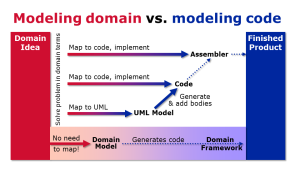
Introduction to Domain-Specific Modeling (11 min) This video introduces you to Domain-Specific Modeling, and demonstrates with a small example how it is different from general purpose modeling languages like UML. |
 |
|
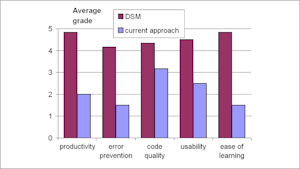
Industrial experiences (16 min) This video describes industrial experiences on DSM in four different domains: home automation, military radio, touch screen device and sports computer applications. |
 |
|
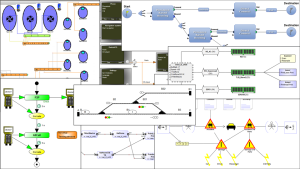
DSM examples (14 min) This video demonstrates Domain-Specific Modeling in 20 different application domains. |
 |
Language and generator definition | |
|
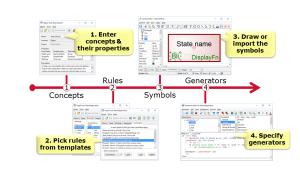
Defining modeling languages and code generators in MetaEdit+ (16 min) This video outlines the steps of creating a DSM solution: Defining the modeling language concepts and rules, drawing the notation and making the code generators. Each step of DSM definition is demonstrated with MetaEdit+. |
|
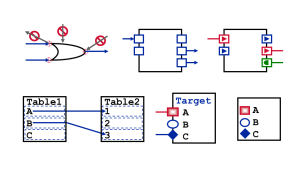
| Rich graphical notations with dynamic behavior (16 min) MetaEdit+ lets you define rich graphical notations with dynamic behavior. A demonstration shows how to create advanced dynamic visualizations and ports for domain-specific languages. |
 |
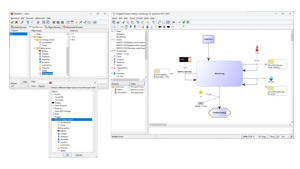
| Modify and refactor your language definition (3 min) This video shows showcases the language refactoring features in MetaEdit+. See how easily language elements can be moved within the metamodel hierarchy, while model data and tool functionality update automatically. |
 |
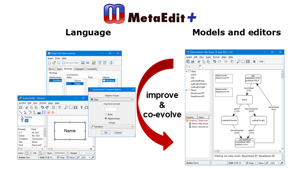
| Co-evolution Support: Never Lose Your Models When Language Evolves (4 min) This video demonstrates how MetaEdit+ supports the co-evolution of modeling languages, models, and tool functionality. When your language evolves, the platform automatically updates models and tool support. If automatic co-evolution isn't possible, MetaEdit+ highlights items requiring your intervention. In every case, you can open your models—your editors never break. |
 |
Language and generator use | |
| MetaEdit+ multi-user support (9 min) This video demonstrates how multiple developers can work seamlessly together with MetaEdit+ multi-user version. |
 |
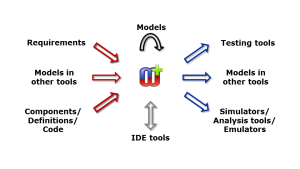
| Model transformations examples (11 min) This video demonstrates different model to model transformations in MetaEdit+: running transformations with external code files, office tools like Excel, XML files, other models in MetaEdit+ and with models outside MetaEdit+. |
 |
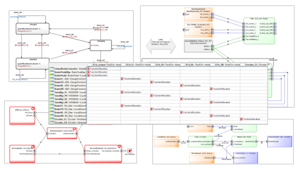
| Scaling to large designs, models and languages (6 min) This video demonstrates scalability of MetaEdit+: large projects, containing hundreds of thousands model elements, open quickly and individual tools like browsers, model editors and generators continue to work as fast as it does for small projects. |
 |
Changes and Versions, Integration with Version Control | |
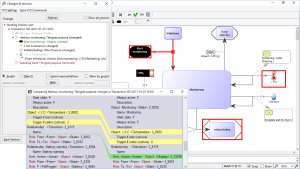
| Tracking model changes and model history (3 min) See how model changes and versions can be tracked and viewed in a tree view, graphically and textually. Versions can be saved to version control systems like Git and SVN. |
 |
|
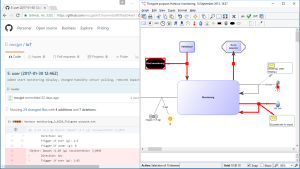
Versioning models with Git and GitHub (3 min) See how models created in MetaEdit+ are versioned with GitHub. |
 |
|
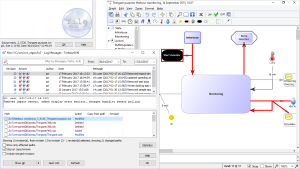
Versioning models with SVN (3 min) See how models created in MetaEdit+ are versioned with SVN. |
 |
Tool integration | |
|
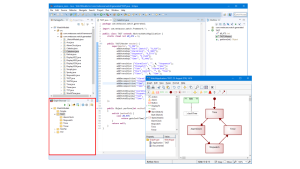
Integrating Eclipse and MetaEdit+ (5 min) This video demonstrates how Eclipse can be integrated with MetaEdit+. |
 |
|
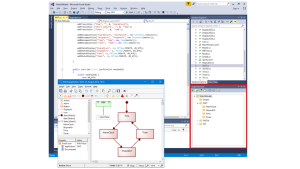
Integrating Visual Studio and MetaEdit+ (5 min) This video demonstrates how Visual Studio can be integrated with MetaEdit+. |
 |
|
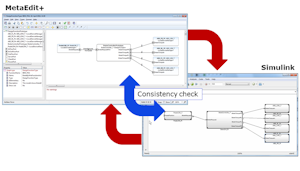
Integrating Simulink and MetaEdit+ (7 min) This video shows how models in MetaEdit+ can be transformed for Simulink and how MetaEdit+ can check consistency between the models in different tools. |
 |
|
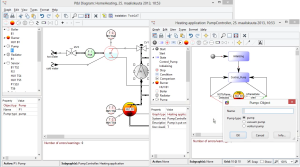
Integrating with PLC system (TwinCAT) (8 min) This video shows how PLC code (IEC Structured Text) is generated from Domain-Specific Models and executed in TwinCAT. |
 |