3.1 Creating a Graph
In this tutorial we will create the metamodel in a top-down
fashion, starting from the graph type and proceeding with objects,
relationships and roles. It is also possible to follow a bottom-up
approach, starting from the language fragments, but for learning purposes we
consider the top-down approach better.
As a top-level or root component of our modeling language,
a
graph in this case encapsulates the concept of
family within a
simple diagram notation. To start creating a new graph type for our family tree
language, open the Graph Tool (shown in
Figure 3-1) by pressing the
Graph
Tool toolbar button or selecting
Metamodel | Graph Tool in the
MetaEdit+ launcher.
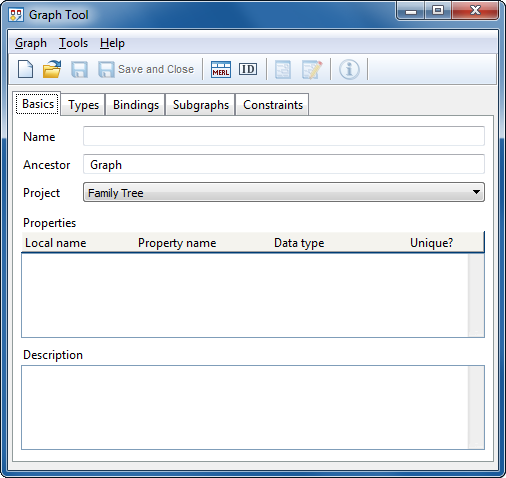
Figure 3-1. Graph Tool.
First, enter the name for our
modeling language (‘Family Tree’) in the Name field. Also
make sure that the project for your new graph type is ‘Family Tree’
(if not, select it from Project’s pull-down list).
Next, we need to state what information can be stored
about a family on the level of the whole graph, e.g. the Family name.
In
GOPPRR such information is stored in a
property. To add a property
to our Family Tree graph, move the mouse over the area of the
Properties
list in the Graph Tool and press the right mouse button. From the pop-up menu
that opens, select
Add Property... to add a property. As there are no
property types defined yet, MetaEdit+ automatically chooses to create a new
property type (if there are already some property types, you will be offered the
choice of using them, but should choose ‘New Property Type’ from the
dialog that opens). This opens a Property Tool for defining a new property type
(shown in
Figure 3-2).
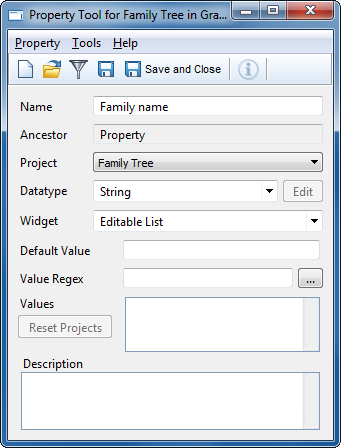
Figure 3-2. Property Tool.
In the Property Tool, enter the
name for the property (‘Family name’). Quite often the other values
within the Property Tool would be correct by default, but in this case we want
to set a different widget type to be used with Family names. As we want to reuse
the Family name property value while populating the Family Tree with family
members, it would be useful if the user could select previously entered values
from a pull-down list, into which each new name will be added. The widget for
this is called an Editable List: choose it from the possible widget types from
the Widget list. Press Save and Close on the toolbar to accept the
changes and to close the Property Tool. As this is the first time you have
generated a type in this session, MetaEdit+ will run a check on all types in the
database. As there are many types in the demo repository, this will take several
seconds – but only for this first time.

Figure 3-3. Graph Tool with the basic definition for Family Tree graph type.
The
basic definition of our Family Tree graph type being complete, the Graph Tool
should now look as in
Figure 3-3. You
can proceed now by pressing the
Save button in the toolbar (not
Save
and Close, because we will continue working with the Graph Tool).
The next step for us is to create the individual language
fragments. This will be done in Graph Tool’s
Types page (shown in
Figure 3-4).
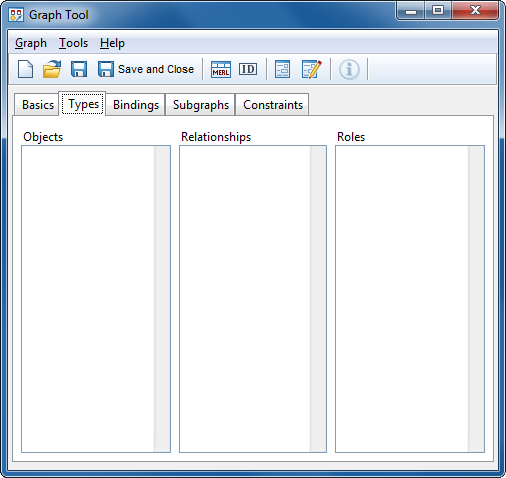
Figure 3-4. Graph Tool’s Types page.
As we can see,
the
Types page provides lists for objects, relationships and roles. The
creation of the types will be discussed in the following
chapters.


